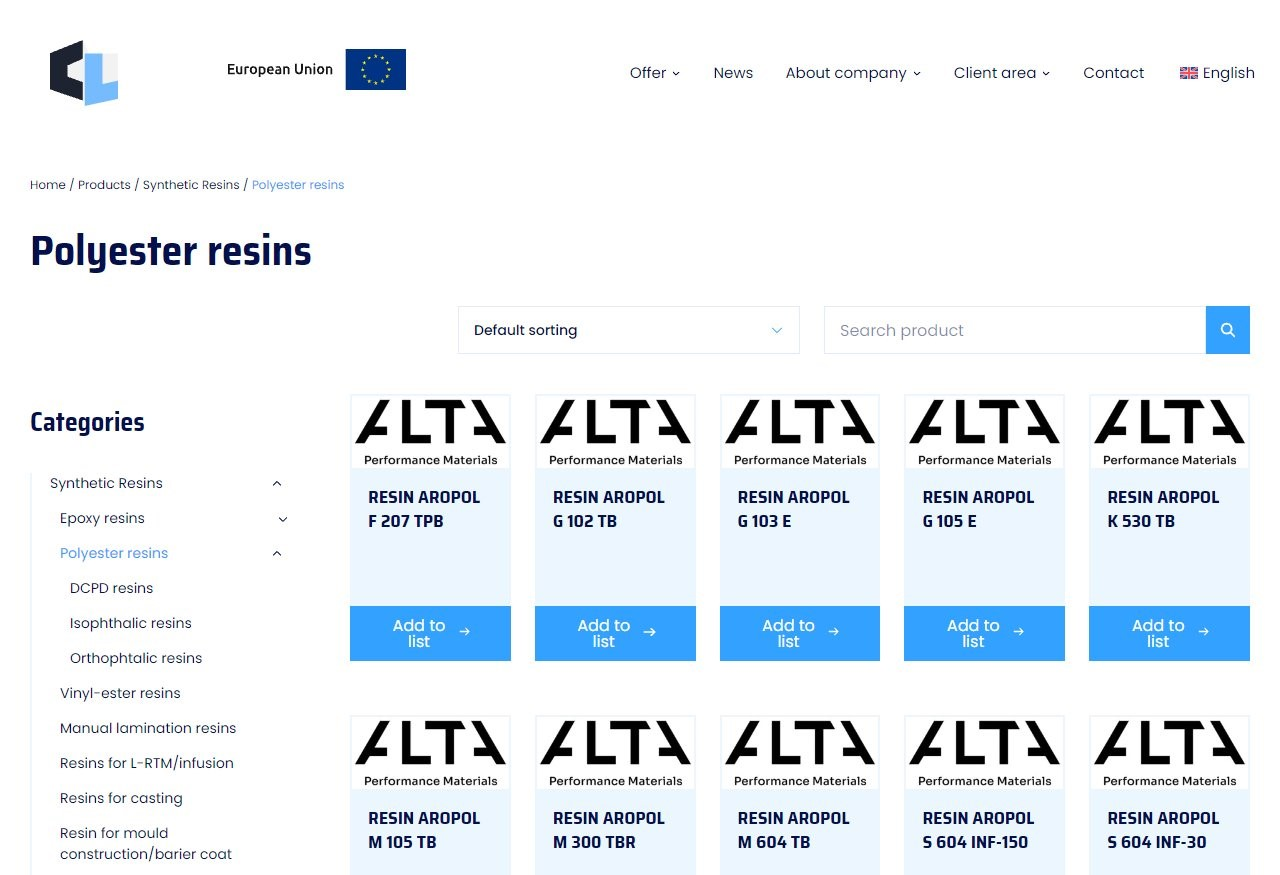
Polyester resins are widely used in the production of laminates, castings and composite components. Their popularity results from their versatility, the ability to adapt their properties to specific manufacturing processes and their relatively easy processing. However, not all products have the same characteristics, so choosing the right material requires considering several important factors. What should you look for to ensure that the selected resin meets the requirements of its intended application?
What types of polyester resins are available?
The first step in choosing a resin is understanding the main types of these materials. Individual products differ in their chemical composition, mechanical properties and resistance to external factors. The selection should primarily depend on the intended use of the finished component.
The most common types include:
- orthophthalic resins, used, among other applications, in the production of standard laminates and castings;
- isophthalic resins, suitable for applications requiring increased resistance to certain environmental factors;
- DCPD resins, used in various lamination processes and the production of composite components.
It is worth comparing the available types of polyester resins, taking into account their properties and recommended applications. This helps narrow down the selection to products that best meet the requirements of a specific manufacturing process.
How to match the resin to its intended application?
One of the most important selection criteria is how the material will be used. Different properties are required when manufacturing decorative elements compared to structures exposed to mechanical loads or moisture.
For example, resins intended for casting should allow proper filling of the mould, while materials used for laminating must ensure effective impregnation of reinforcing fibres. For components used in demanding conditions, chemical resistance and stability of properties within a specific temperature range may also be important.
Therefore, when selecting polyester resins, it is essential to clearly define the intended purpose of the finished product and its operating conditions. This approach helps reduce the risk of using a material with insufficient performance characteristics.
Why are viscosity and gel time important?
The processing parameters of a resin directly affect the manufacturing process. Viscosity is particularly important, as it determines the material’s resistance to flow. Lower-viscosity resins may be suitable for processes requiring thorough impregnation of reinforcing materials, while products with different rheological properties are used in technologies where resin flow needs to be limited.
Another important parameter is gel time, which refers to the period after which the prepared mixture begins to lose its fluidity. A gel time that is too short can make it difficult to manufacture larger components, while a longer one may affect production organisation and efficiency.
When working with polyester resins, it is also necessary to consider ambient temperature and recommendations regarding the use of curing initiators. These factors influence the chemical reactions and properties of the finished material.
How to evaluate the resin’s resistance and mechanical properties?
Before purchasing, it is worth analysing the parameters that determine how the material performs after curing. Important factors include mechanical strength, stiffness, chemical resistance and heat deflection temperature.
The mechanical properties of the finished composite also depend on the type of reinforcement, its proportion within the structure and the curing conditions. Therefore, the properties of the resin itself should be considered in the context of the entire manufacturing process.
What else should you consider before purchasing?
In addition to the type of resin and its technical parameters, it is important to check its compatibility with other materials used during production. Key considerations include the type of reinforcement, curing system and application technology.
Before choosing a specific product, it is also advisable to review its technical data sheet and safety data sheet. These documents provide information about recommended processing conditions, storage requirements and safe handling procedures.
When comparing polyester resins, price should not be the only deciding factor. A cheaper material may be less suitable for a particular technology, potentially leading to manufacturing problems or increased raw material consumption.
How to make the right decision when choosing a polyester resin?
Selecting the right polyester resin requires considering both its technical properties and the conditions of the planned manufacturing process. The most important factors include the material’s intended application, viscosity, gel time and resistance to operating conditions. Carefully reviewing product documentation and comparing available solutions helps minimise the risk of errors and select a material suited to specific needs.
Polyester resins – C-L
Address: Redzikowo, Przemysłowa 14, 76-200 Słupsk, Poland
Telephone: +48 59 845 22 83
Website: https://c-l.eu/