
API-First Ecommerce Development: Benefits, Use Cases, and Key Considerations
[[ZAPIMG0]]
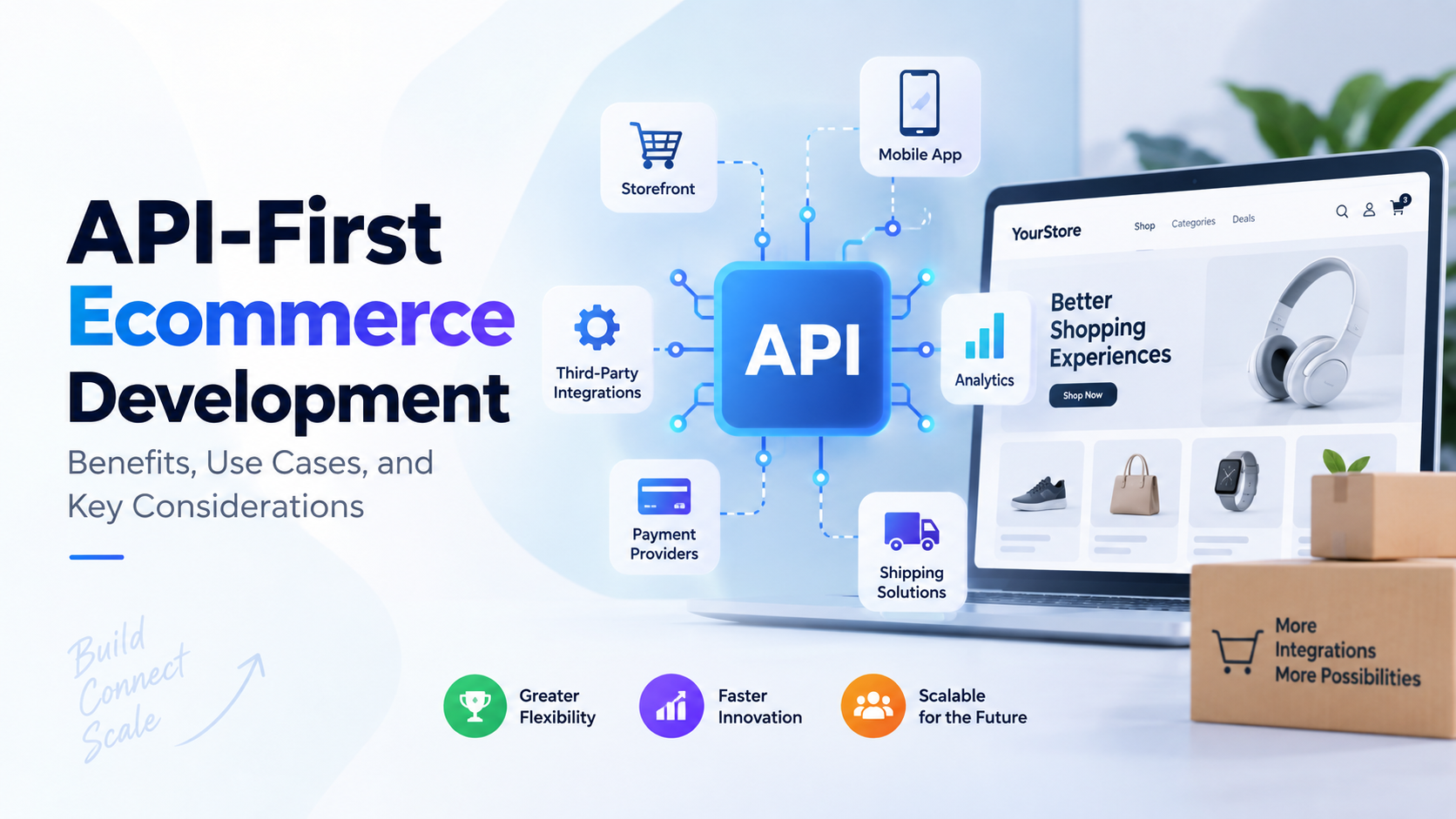
API-first ecommerce development is an approach where every piece of a store's functionality, catalog, cart, checkout, search, pricing, is built as an independent service accessible through an API, rather than baked into one rigid platform. Instead of buying a single monolithic system and hoping it can keep up with your roadmap, you assemble the stack from interchangeable components and connect them through well-documented APIs. That's the short version. The longer version is where it gets interesting for anyone actually running a store.
Retailers have spent the last few years quietly abandoning the "one platform does everything" model. It's not a fad. Brands that once needed six months to launch a new checkout flow now do it in weeks, sometimes days, because the checkout isn't welded to the catalog engine anymore. This shift matters if you're evaluating a replatform, planning international expansion, or just tired of waiting on vendor release cycles to ship a feature your competitor already has.
This piece walks through what API-first architecture actually means, where it delivers real value, where it doesn't, and what a business needs to have in place before attempting it. If you're considering AI powered Ecommerce development as part of a modernization plan, understanding the API-first foundation first will save you from expensive missteps later.
What Does API-First Actually Mean?
People throw around "headless," "composable," and "API-first" like they're interchangeable. They're related, but not identical.
Headless commerce separates the frontend (what shoppers see) from the backend (where the logic lives). Composable commerce takes that further, letting you assemble the entire stack from best-of-breed components, like Lego bricks, rather than one vendor's suite. API-first is the underlying principle that makes both possible. It means every capability, whether that's inventory, promotions, or subscriptions, is designed from day one to be accessed and controlled through an API, not as an afterthought bolted onto a legacy system.
Think of it this way: a monolithic platform builds the frontend and backend as one tightly coupled unit. If you want to change how the checkout looks, you're often touching code that also runs the database and the admin panel. An API-first system keeps these layers cleanly separated. The frontend calls an API. The API talks to whatever backend service is doing the work. Swap the frontend, swap a backend service, doesn't matter. Nothing else breaks.
Gartner's own research frames this clearly: composable, API-based digital commerce continues to gain strong traction as adoption accelerates, and the firm has recognized this shift explicitly in its 2026 Hype Cycle for Digital Commerce. That's not marketing language from a vendor. That's an independent analyst firm tracking where enterprise budgets are actually going.
Why Businesses Are Making the Switch
Honestly, most businesses don't switch because API-first sounds impressive on a slide deck. They switch because the old way started costing them money, customers, or both.
Speed to market. In a monolithic setup, a small frontend change can require a full regression test across the entire platform. With API-first architecture, teams update the storefront independently of the backend. A recent industry report found that 92% of US brands have already implemented some form of composable commerce, with another 21% planning to follow within the year. That's not a niche trend anymore. That's close to becoming the default.
Omnichannel without duct tape. Shoppers move between mobile apps, websites, marketplaces, in-store kiosks, and increasingly, AI shopping assistants. An API-first backend serves all of these from the same source of truth. You're not maintaining five separate integrations that quietly drift out of sync with each other.
Faster feature releases. Gartner has projected that organizations with mechanisms to reuse composable commerce modules could see innovation speed improve by 60% compared to earlier benchmarks. That's a meaningful number when your competitor ships a new loyalty feature and you're stuck waiting for your platform vendor's next quarterly release.
Scalability under load. Enterprise platforms built on microservices and API-first principles are now handling extremely high transaction volumes, some reportedly processing up to 18,000 transactions per second during peak load. Monolithic systems tend to buckle or require expensive vertical scaling to hit numbers anywhere close to that.
Better AI and agent readiness. This is the part most articles on this topic miss entirely. As AI shopping agents start placing orders, comparing prices, and negotiating on behalf of consumers, they need clean, structured API access to product data, pricing, and checkout flows. A platform built with tightly coupled frontend and backend logic simply isn't built to serve a machine client the same way it serves a human browser. Composable, API-first stacks are structurally ready for this shift because they already separate presentation from logic. Monolithic platforms are having to retrofit this capability, often clumsily.
That last point deserves more attention than it usually gets. Agentic commerce isn't theoretical anymore. Gartner's 2026 Hype Cycle specifically calls out composable commerce as the more natural foundation for AI-driven and agentic applications, precisely because these systems allow easier integration and automation than monolithic platforms do. If your roadmap includes any kind of AI-driven shopping experience, this is worth building around now rather than retrofitting in two years.
Real Use Cases Where API-First Delivers Results
Theory is fine, but let's get specific about where this actually pays off.
B2B ecommerce with complex pricing logic. B2B buyers expect account-specific pricing, tiered discounts, custom catalogs per client, and quote workflows. Bolting this onto a rigid B2C platform usually means workarounds and technical debt. An API-first pricing engine can serve these rules to any frontend, whether that's a self-service portal, a sales rep's internal tool, or a partner marketplace, without duplicating logic three times.
Multi-brand and multi-region retailers. A company running five brands across three countries doesn't want five separate platform instances. API-first architecture lets a single backend serve multiple storefronts, each with its own currency, language, and design, while sharing inventory and order management underneath.
Subscription and recurring commerce. Subscription logic, proration, upgrades, pause and resume, cancellation flows, is notoriously messy to bolt onto traditional platforms. A dedicated subscription API, connected into the broader stack, handles this cleanly without forcing the entire catalog system to understand billing cycles.
Mobile-first and app-heavy brands. If your primary customer touchpoint is a native app rather than a browser, API-first architecture is close to mandatory. Native apps need lightweight, fast API responses, not a full webpage rendering pipeline.
Marketplace and multi-vendor models. Platforms bringing together multiple sellers, each with their own inventory, shipping rules, and payout schedules, benefit enormously from modular services that can scale independently. Order management doesn't need to know about seller onboarding logic, and vice versa.
Retailers integrating AI search and personalization. Modern product discovery increasingly relies on AI-driven search and recommendation engines that need real-time access to catalog and behavioral data. That only works cleanly through APIs. Bolting an AI search layer onto a closed monolithic system usually means expensive, fragile custom integration work, if it's even possible at all.
API-First vs Monolithic: A Direct Comparison
Neither side of this table is universally "better." A small store with a simple catalog and no plans for rapid expansion might genuinely be fine on a monolithic platform for years. That's a legitimate business decision, not a failure to modernize.
Technical Considerations Nobody Mentions Upfront
This is usually where guest posts on this topic go quiet, because it's the less flattering part of the conversation.
API management gets complicated fast. Once you have a dozen or more services talking to each other, you need proper API gateways, rate limiting, versioning strategy, and monitoring. Without this, a single slow or failing service can quietly degrade the entire storefront experience, and it can take hours to figure out which service is actually at fault.
Security surface area increases. Every API endpoint is a potential attack vector. Authentication, authorization, and data validation need to happen consistently across every service, not just at a single login gate like older platforms assumed. Skipping this step is a common and expensive mistake.
Team skill requirements shift. Monolithic platforms often let a smaller, less specialized team manage the whole system through an admin panel. API-first architecture typically needs developers comfortable with REST or GraphQL, integration patterns, and distributed systems debugging. That's a real hiring or training cost, and it's often underestimated during initial planning.
Third-party integration complexity. ERPs, payment gateways, tax engines, shipping providers, loyalty platforms. Each needs its own integration, and API-first doesn't magically make every vendor's API well-documented or reliable. Budget real time for this. It's rarely as clean as the sales deck implies.
Versioning discipline matters. When five different frontends depend on the same API, you can't just change the API's behavior overnight. Poor versioning discipline breaks storefronts in production, sometimes silently. This is often overlooked until it causes an outage.
Governance for agentic access. As AI agents start querying commerce APIs directly, businesses need clear policies on what data agents can access, how pricing is exposed, and how fraud prevention adapts when the "customer" might be a bot acting on a human's behalf. This is a genuinely new consideration, and most existing playbooks don't cover it yet.
What Migration Actually Costs and Takes
Here's where a lot of vendors get vague, and it's worth being direct instead.
A phased approach, replacing one component like search or checkout while keeping the rest of the existing platform, typically runs in the range of $50,000 to $200,000 for the first component, over roughly 6 to 12 weeks. A full replatform to a completely composable, API-first stack is a bigger undertaking, often landing somewhere between $500,000 and $2 million or more, spread across 6 to 12 months, depending heavily on catalog complexity, integration count, and team capability.
That range varies a lot by provider and scope, so treat it as a planning benchmark, not a quote. Businesses with a smaller catalog and fewer integrations land toward the lower end. Enterprise retailers with complex B2B pricing, multiple regions, and legacy ERP dependencies land toward the higher end, sometimes well past it.
A phased migration is usually the more realistic path for mid-market brands. Full replatforms carry more risk and more upfront cost, and they tend to make sense only when the existing platform has genuinely hit a ceiling it can't grow past.
Common Migration Mistakes
Underestimating integration work. Teams often budget for the new frontend and backend but forget how much time gets consumed reconnecting ERP, tax, shipping, and loyalty systems that worked fine on the old monolith.
Treating it as a pure technical project. API-first migration touches marketing, merchandising, and customer service workflows too. Leaving those teams out of planning creates friction after launch, not before.
Skipping the skills gap. Hiring or training happens too late, usually after the project has already stalled because nobody on staff can debug a failing microservice at 2 a.m.
No clear rollback plan. Things go wrong during migrations. Not always, but often enough that skipping a rollback strategy is a real risk, not a hypothetical one.
Chasing every trend at once. Some businesses try to adopt AI search, subscriptions, marketplace features, and a full replatform simultaneously. That's usually a recipe for a project that never ships. Sequencing matters more than most roadmaps admit.
Is Your Business Actually Ready for This?
Not every business needs API-first architecture right now, and that's a fair thing to admit. A few honest questions help clarify readiness:
- Are you adding new sales channels (marketplaces, apps, kiosks) faster than your current platform can support?
- Does your current platform force workarounds for pricing, catalog, or checkout logic?
- Is your development team spending more time fighting platform limitations than building new features?
- Are you planning for AI-driven search, personalization, or agentic shopping experiences in the next 12 to 24 months?
- Do you have, or can you build, the internal or agency-supported technical capability to manage a distributed system?
If most answers point toward growth constraints and channel expansion, API-first is probably worth the investment. If your catalog is small, stable, and single-channel, a simpler platform might genuinely serve you better for now. There's no prize for adopting complex architecture before you need it.
Businesses evaluating this path often also look into composable commerce as a lower-risk entry point, since it allows replacing individual components without committing to a full replatform on day one. Pairing this with proper ecommerce ERP integration planning early on tends to prevent a lot of the integration headaches described above.
Where This Is Heading
The next couple of years will likely push API-first architecture from "advanced option" to baseline expectation, particularly as AI agents become a real transaction channel rather than a novelty. Gartner's positioning of composable, API-based commerce as the natural foundation for agentic applications isn't a small detail. It suggests that businesses still running closed, tightly coupled platforms may find themselves structurally unable to participate in AI-driven commerce channels at all, not just slower to adopt them.
That doesn't mean every business needs to replatform tomorrow. It does mean the businesses planning their next three-year roadmap should factor this in now, rather than treating it as next year's problem.
Frequently Asked Questions
What is API-first ecommerce development?
API-first ecommerce development is an approach where every commerce function, such as catalog, cart, checkout, and pricing, is built as an independent service accessible through an API. This allows businesses to assemble, replace, or scale individual parts of their commerce stack without rebuilding the entire system.
Is API-first the same as headless commerce?
Not exactly. Headless commerce separates the frontend from the backend. API-first is the underlying design principle that makes headless, and more advanced composable architectures, possible in the first place.
How much does API-first ecommerce development cost?
Phased adoption, replacing a single component like search or checkout, typically costs between $50,000 and $200,000 over 6 to 12 weeks. A full replatform can range from $500,000 to $2 million or more, depending on catalog size, integrations, and team capability.
Is API-first architecture only for large enterprises?
No, though enterprises adopt it most visibly. Mid-market brands planning multi-channel expansion or facing platform limitations often benefit from a phased, component-by-component approach rather than a full rebuild.
What are the biggest risks of moving to API-first architecture?
The most common risks are underestimating third-party integration work, skipping proper API governance and security planning, and not having a team with the right technical skills to manage a distributed system.
Does API-first architecture help with AI and agentic commerce?
Yes. Because API-first systems already separate presentation from business logic, they're structurally better positioned to serve AI shopping agents, which need clean, structured access to product and pricing data. Monolithic platforms typically require significant retrofitting to support this.
How long does a full API-first migration take?
A full replatform generally takes 6 to 12 months depending on complexity. A phased approach, tackling one component at a time, can show results in as little as 6 to 12 weeks per component.
Can I move to API-first architecture without a full replatform?
Yes. Many businesses start by replacing a single high-impact component, like search, checkout, or product information management, while keeping the rest of their existing platform. This lowers risk and cost compared to a complete rebuild.
Does API-first architecture improve site speed?
It can, indirectly. Because frontend and backend are decoupled, teams can optimize storefront performance independently. Site speed matters commercially too. Research has shown ecommerce sites loading in one second convert roughly three times higher than sites taking five seconds to load.
What team skills are needed to manage an API-first stack?
Teams typically need developers comfortable with REST or GraphQL APIs, integration patterns, API security practices, and distributed systems troubleshooting. This is a meaningful shift from managing a single vendor-hosted platform through an admin panel.
What industries benefit most from API-first ecommerce?
B2B businesses with complex pricing, multi-brand or multi-region retailers, subscription commerce models, mobile-first brands, and marketplace operators tend to see the clearest returns from API-first architecture.
Should every ecommerce business switch to API-first architecture?
No. Businesses with small, stable catalogs and no plans for channel expansion may not need the added complexity. API-first architecture delivers the most value for businesses facing genuine growth, channel, or integration constraints.
Final Thought
API-first ecommerce isn't a buzzword anymore, and frankly, treating it as one is how businesses end up either overbuilding a system they don't need or underestimating one they genuinely do. The right move depends on where your platform is actually failing you today, not where the industry says you should be in three years.
If your team is evaluating whether to phase into composable components or commit to a fuller rebuild, working with a team that's handled both paths matters more than picking a trendy architecture pattern. Businesses looking to scope this properly, and avoid the integration and governance mistakes covered above, can hire eCommerce developer talent that has actually shipped API-first systems in production, not just diagrammed them on a whiteboard.