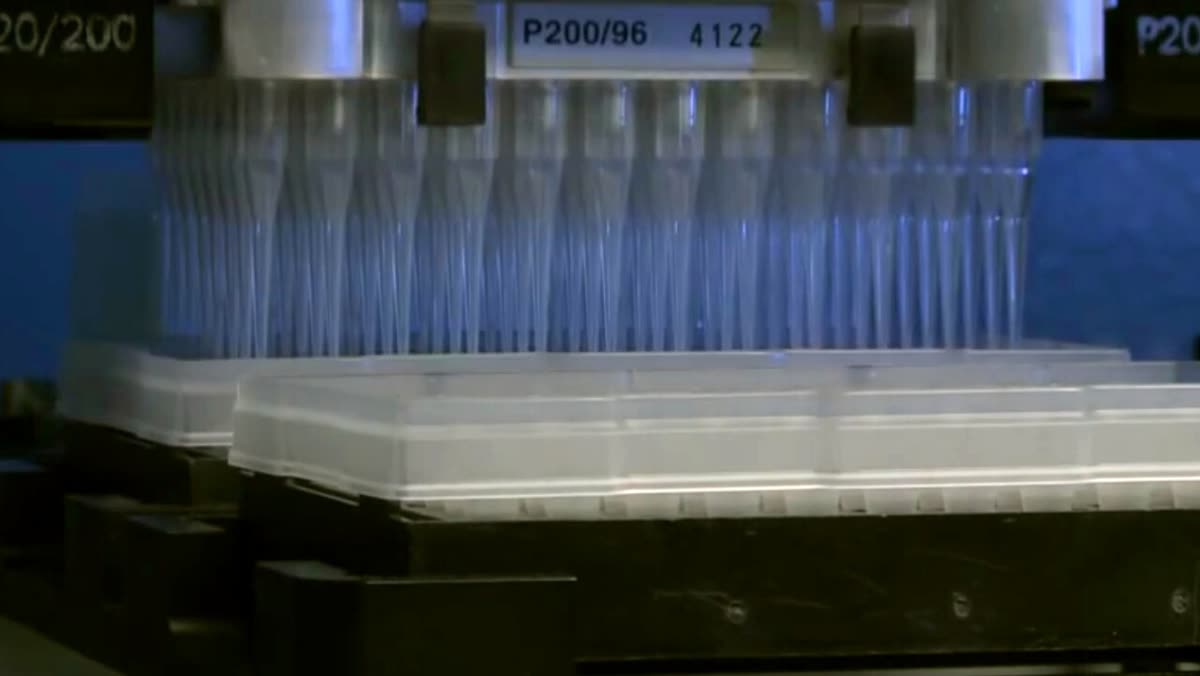
Walk through a research building late in the evening and you can usually still find someone hunched over a bench, pipetting the same volume into the same plate for the ninth time that day. The work is careful and it is also the least interesting part of the job.
That picture is changing faster than most people outside the lab realize. Robotic liquid handlers, barcoded sample tracking, scheduling software that talks directly to instruments, and analysis pipelines that fire the moment a plate leaves the reader have moved out of specialist screening facilities and into ordinary labs. The hardware costs less, the software asks less of the user, and the pressure to produce more data with the same headcount has not eased.
So the real story is not about robots. It is about where scientific attention goes. When the repetitive layer gets handed to a machine, the human layer moves upward, toward experimental design, toward interpretation, toward asking the second and third question instead of grinding through the first.
The Shift From Manual Benchwork to Automated Workflows
A decade ago, automation in most labs meant one costly instrument doing one narrow thing, operated by the single person trained on it. Today it looks more like a chain. Samples arrive, get registered, get aliquoted by a liquid handler, travel to an incubator or plate reader, and their results land in a database without anyone transcribing a number.
Modularity explains how quickly this spread. Rather than buying a monolithic workstation that locks a lab into one workflow for a decade, teams assemble smaller units they can rearrange as projects change. Industry coverage from SLAS 2026 described that shift, with vendors reporting that buyers now ask about return on investment per device and expect cross-vendor compatibility rather than closed ecosystems.
Public institutions push the logic further. The Autonomous Formulation Lab at NIST couples robotic sample preparation with in-situ scattering measurements in a closed loop, so the platform runs an experiment, learns from the result, and chooses what to measure next.
Consistency Is the Quiet Benefit That Changes Results
Ask a lab manager what automation bought them and the answer is rarely speed. It is consistency. A robot pipettes the two hundredth sample the way it pipetted the first, holds incubation timing to the second, and does not get distracted halfway through a dilution series. Operator-to-operator variability, the kind that quietly widens error bars and sinks a replication attempt, shrinks considerably.
That matters beyond tidy data. Reproducibility has been a sore subject across the life sciences for years, and much of the problem traces back to undocumented procedural drift rather than anything exotic. Automated systems record what they did, when, and with which reagent lot, turning a protocol from a paragraph of prose into an executable record. A recent volume of SLAS Technology devoted a special issue to robotics in the lab for exactly this reason, highlighting gains in precision, reproducibility, and throughput.
Sample Handling Turns Into a Tracking Problem Worth Solving
Growth in sample volume breaks manual tracking before it breaks anything else. Freezer inventories drift out of date, handwritten labels smudge, and someone eventually spends an afternoon hunting for a tube logged twice under two spellings. Automated registration, barcoding, and instrument integration fix most of that by making a sample’s identity machine-readable the moment it enters the building.
Vendors building lab automation platforms now treat chain of custody as a core feature rather than a compliance afterthought, since regulated environments demand a traceable path from specimen to reported result. Outside regulated work the same infrastructure pays off differently: when metadata is captured automatically, a dataset stays usable three years later, which is roughly when somebody wants to reanalyze it.
Scientists Get Their Thinking Time Back
The most underrated effect is simple arithmetic on a calendar. Hours spent dispensing, labeling, and keying in numbers are hours not spent reading, designing, or arguing productively about what a result means. Hand those hours back and the shape of the week changes.
The pattern is not unique to science. Any organization that automates its routine administrative layer tends to find it can absorb more work without adding staff, a dynamic described well in this account of how small teams scale operations without growing an admin department. Labs land in the same place, except the output is experiments rather than enrollments.
There are limits worth naming. Automation amplifies a bad protocol as faithfully as a good one, validation takes real effort before a workflow can be trusted, and a platform nobody can troubleshoot becomes an expensive shelf ornament.
What automation does not do is science. It cannot decide which hypothesis deserves testing, notice that an anomaly is interesting rather than erroneous, or judge whether a finding holds up.
Which is the point. The labs getting the most from this shift are not the ones with the most robots; they are the ones that worked out which tasks never needed a scientist, moved those off the bench, and spent the recovered time on questions they previously had no room to ask.