
Why a Generative AI Course for Finance Professionals is No Longer Optional
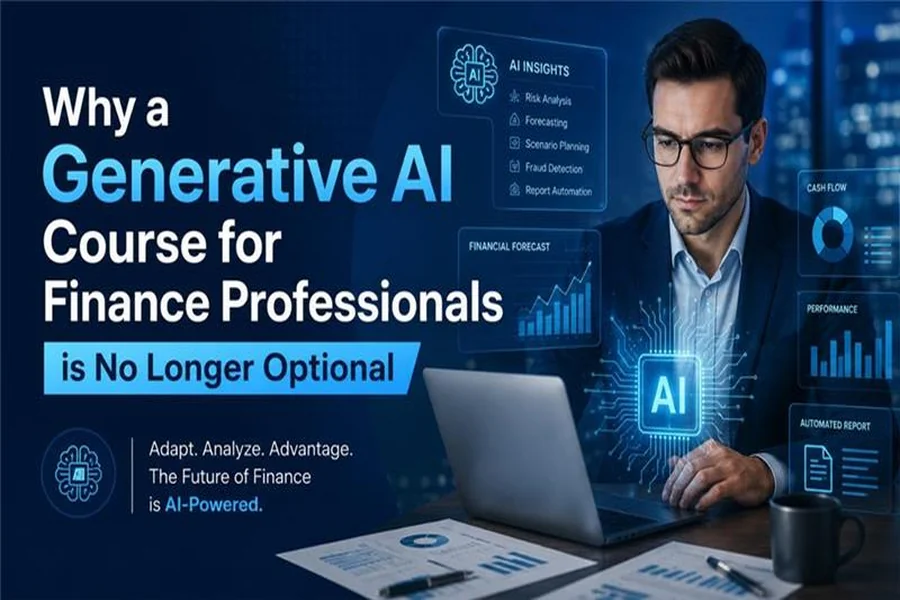
Finance has always been an industry driven by information, speed, and precision. Today, a new technology is reshaping how financial professionals work: generative AI. From automating research tasks to accelerating financial reporting, AI-powered tools are rapidly becoming part of everyday workflows across banking, accounting, investment management, insurance, and corporate finance.
suggest that AI can significantly reduce the time spent on repetitive knowledge-based tasks, allowing professionals to focus on strategic decision-making and higher-value activities. What once required hours of manual analysis can now be completed in minutes with the right AI-assisted workflows.
The message is becoming increasingly clear: generative AI is transforming core finance functions, and professionals who understand how to use it effectively will be better positioned to remain competitive, compliant, and valuable in a changing marketplace.
This article explores why learning generative AI has become essential for finance professionals, covering productivity improvements, enhanced decision-making, risk management considerations, career opportunities, and what to look for in a quality learning program.
What Is Generative AI and Why Does It Matter for Finance?
Generative AI refers to artificial intelligence systems capable of creating new content, insights, code, summaries, analyses, and recommendations based on large datasets and natural language instructions. Unlike traditional automation tools that follow predefined rules, generative AI can interpret context, generate responses, and assist with complex knowledge work.
Examples of generative AI capabilities include:
- Drafting reports and presentations
- Generating code for financial analysis
- Summarizing earnings calls and market research
- Extracting information from financial documents
- Creating forecasting scenarios
- Producing client communications and investment summaries
For finance teams, these capabilities have practical applications across numerous workflows. Analysts can accelerate financial modeling, accountants can automate portions of reporting processes, and investment professionals can quickly synthesize large volumes of market information.
It’s important to distinguish generative AI from traditional automation. Conventional automation performs predefined repetitive tasks, while generative AI supports cognitive work that previously required significant human effort. This makes it particularly valuable in finance, where professionals routinely analyze large amounts of structured and unstructured data.
Efficiency and Productivity Gains
One of the strongest reasons to invest in learning AI is its ability to improve operational efficiency.
Finance professionals spend substantial time gathering information, validating data, creating reports, preparing presentations, and documenting findings. Many of these tasks are essential but highly repetitive. Generative AI can significantly reduce the manual effort involved.
Consider several common use cases:
- Creating earnings-call summaries from transcripts
- Drafting management reports
- Generating Excel formulas and analytical scripts
- Producing investment research outlines
- Automating portions of regulatory documentation
- Accelerating reconciliation workflows
Instead of manually reviewing hundreds of pages of documents, professionals can use AI tools to identify key themes, summarize findings, and highlight potential risks. This allows teams to allocate more time to interpretation and strategic analysis.
The productivity gains can be substantial. Even modest reductions in administrative workload can create meaningful cost savings when multiplied across entire finance departments. Organizations increasingly recognize that AI literacy is not simply a technology initiative – it is a workforce productivity initiative.
This is one reason why demand for a generative AI course for finance professionals continues to grow. Companies want employees who understand both financial processes and the responsible application of AI tools.
Improved Decision-Making and Analytics
Beyond efficiency, generative AI can enhance decision quality by helping professionals analyze information more effectively.
Modern finance involves evaluating large volumes of data from multiple sources, including financial statements, market reports, news articles, economic indicators, regulatory filings, and customer information. Processing this information manually can be time-consuming and challenging.
Generative AI acts as a force multiplier by:
- Synthesizing unstructured information
- Identifying emerging patterns
- Generating alternative scenarios
- Supporting sensitivity analysis
- Producing investment hypotheses
- Highlighting key variables that may influence outcomes
For example, analysts can use AI to create multiple economic scenarios and evaluate how different assumptions may affect financial performance. Investment teams can explore alternative market narratives and identify risks that may not have been immediately obvious.
Stress testing and scenario planning can also become more efficient. Rather than building each scenario manually, professionals can generate multiple possibilities and refine them using domain expertise.
However, AI should not replace professional judgment. Outputs generated by AI systems require validation, verification, and contextual interpretation. Finance professionals remain responsible for ensuring that recommendations are accurate, relevant, and aligned with business objectives.
The most effective approach combines human expertise with AI-assisted analysis rather than relying exclusively on either one.
Risk, Compliance, and Governance Imperatives
As organizations increase AI adoption, they also face new categories of risk.
Generative AI systems can occasionally produce inaccurate information, create misleading conclusions, or generate outputs that lack sufficient transparency. In highly regulated industries such as finance, these risks require careful management.
Key concerns include:
- Hallucinated or inaccurate outputs
- Data privacy and confidentiality risks
- Model bias and fairness issues
- Regulatory compliance challenges
- Limited explainability
- Audit and documentation requirements
For this reason, AI literacy must extend beyond productivity benefits. Finance professionals need a clear understanding of governance frameworks and risk controls.
Training should include topics such as:
- Prompt engineering best practices
- Output validation techniques
- Documentation and audit trails
- Data security requirements
- Responsible AI principles
- Regulatory expectations
Regulators, central banks, and financial oversight bodies continue to evaluate how AI should be governed within financial institutions. As guidance evolves, professionals who understand both financial regulations and AI governance will become increasingly valuable.
Organizations are also strengthening internal controls around AI usage, making formal training an important component of responsible implementation.
Competitive and Career Reasons
The workforce implications of AI are becoming increasingly visible.
Employers are actively seeking professionals who can combine financial expertise with technological capabilities. New roles are emerging that blend traditional finance responsibilities with AI-enabled analysis and automation.
Examples include:
- AI-enabled financial analysts
- Finance transformation specialists
- AI governance and risk professionals
- Quantitative analysts using large language models
- Automation and process optimization leaders
Professionals who understand AI tools can often complete tasks more efficiently, contribute to innovation initiatives, and support digital transformation projects. These capabilities can improve career growth opportunities and increase long-term adaptability.
From an employer perspective, upskilling existing talent is often more effective than hiring entirely new teams. As a result, many organizations are investing heavily in workforce development and AI education programs.
Learning generative AI for finance professionals is increasingly becoming a strategic career decision rather than a technical specialization.
What a Good Generative AI Course for Finance Should Cover
Not all AI training programs are created equal. Finance professionals should look for courses that balance technical knowledge with practical business applications.
A comprehensive curriculum should include:
Foundations of Generative AI
Participants should understand how large language models, generative systems, and modern AI architectures function. This foundational knowledge helps users make informed decisions about appropriate use cases and limitations.
Applied Prompt Engineering
Prompt design directly influences output quality. Learners should develop skills for creating structured prompts that support financial analysis, reporting, forecasting, and research workflows.
Finance-Specific Use Cases
Courses should include practical applications such as:
- Financial modeling support
- Investment research workflows
- Regulatory reporting
- Risk analysis
- Portfolio management
- Client communication automation
Model Evaluation and Validation
Professionals must learn how to assess output quality, identify inaccuracies, and establish validation procedures before relying on AI-generated recommendations.
Data Governance and Security
Training should address data privacy, confidentiality requirements, cybersecurity considerations, and governance frameworks relevant to financial institutions.
Coding and No-Code Integration
Modern finance teams benefit from understanding both technical and no-code AI solutions. Exposure to APIs, workflow automation tools, and analytics platforms can expand implementation options.
Practical Learning Experiences
The most effective programs include:
- Hands-on labs
- Real-world finance datasets
- Case studies
- Knowledge assessments
- Capstone projects
- Workflow design exercises
Providers such as SkillUp Online emphasize practical application because real business value comes from implementing AI effectively, not simply understanding the theory.
Counterarguments and Mitigations
Some professionals remain skeptical about AI adoption.
Common concerns include training costs, uncertainty about long-term value, fears of job displacement, and the complexity of governance requirements.
These concerns are understandable, but they can be addressed through a structured approach.
Training investments are often offset by productivity gains and operational efficiencies. Rather than replacing finance professionals, AI is increasingly augmenting their capabilities and allowing them to focus on higher-value work.
Organizations can also reduce implementation risk through phased adoption strategies. Starting with low-risk use cases, establishing governance frameworks, and providing targeted education can create sustainable outcomes without disrupting existing operations.
The goal is not to replace expertise but to enhance it.
Conclusion
Generative AI is no longer a future trend for finance – it is becoming a core component of modern financial operations. Professionals who understand how to use AI responsibly can improve efficiency, strengthen decision-making, manage emerging risks, and position themselves for long-term career success.
The organizations that invest in AI skills today will be better prepared for tomorrow’s competitive landscape. Whether you’re an analyst, accountant, finance manager, or investment professional, now is the time to build the knowledge needed to work effectively alongside AI.
Consider enrolling in a training program, piloting an internal use case, or launching an upskilling initiative. The sooner finance professionals develop AI literacy, the greater their ability to lead rather than react to industry change.