
Verdana Font – A Clear Choice for Screen Design
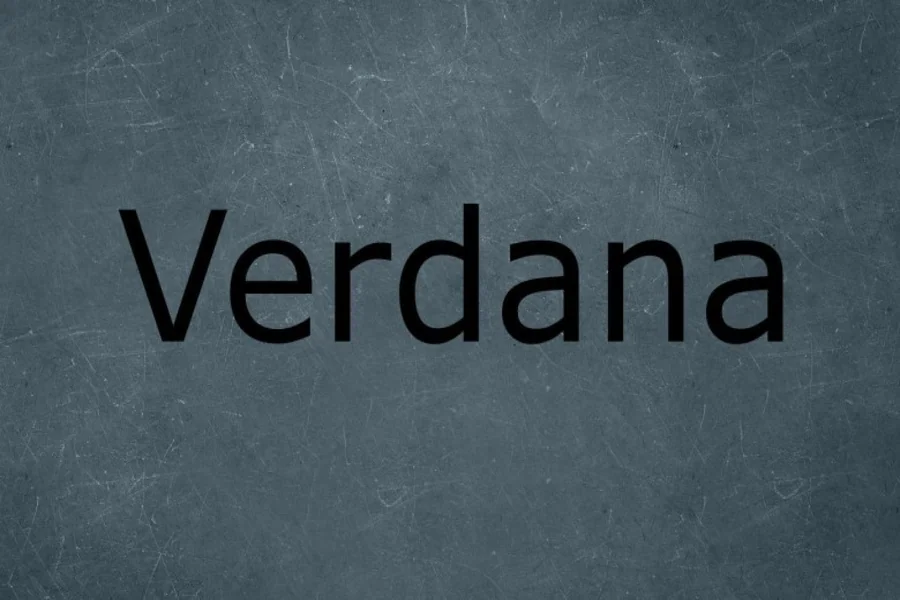
Verdana font is one of the reliable digital content typeface since the inception of the web. It was created as an on-screen user, and soon became a popular tool among web designers and developers, as well as content creators. A clear font, unlike most traditional serif or decorative fonts, was designed by Verdana. It has big letter spacing, high x-height, and open forms which allow reading even at small sizes. In the course of time it has been demonstrated that even the most basic of design decisions can affect user experience in a significant way.
The History and Creation of Verdana font
Verdana is a font designed in 1996 by Matthew Carter a type designer employed by Microsoft. Computer screens were of low-resolution then, and most fonts that were classy on paper were hard to read on screens. Microsoft desired a typeface that could be optimally used on a screen and could be legible at a relatively smaller size.
Matthew Carter was an artist who did not emphasize on decoration but functionality of the project. Each character on the typeface was sketched to create the greatest clarity. The distance in between characters was deliberately broad. The forms were non-obtrusive and clear. Using the lower case of the letter l and upper case of the letter I as an example, there was a distinct difference between them to create no confusion. These considerate design features were useful in making the typeface stand out.
After its release, Verdana was packaged with Windows and was subsequently made very popular in other environments. The fact that it is available in systems that are safe and reliable made it a reliable option to websites when internet was growing at an early age.
Key Features That Make It Unique
The large x-height of Verdana font is one of the most evident. x-height is defined as the height of lower case letters such as x against upper case letters. The lower case letters are not very short in Verdana, and this enhances the screen readability. This design enables the text to still be legible even when it is used in smaller fonts.
The wide letter spacing is another characteristic. Whereas there are fonts that appear to be condensed and narrow, verdana provides some space between characters. This minimizes congestion in the eyes and simplifies the scanning of paragraphs. This was a big plus in the case of digital reading, particularly in older monitors or small mobile devices.
Wide proportions are also contained in the font. Letters like m and w are wider than in most other typefaces in the sans serif category. This also adds to its unique look and enhances readability. The punctuations and figures were also to be designed well to be legible and well-balanced.
Verdana is a typeface that is a sans serif, that is, it lacks small ornamental strokes at the terminal of letters. This primitive design of it helps to create its modern and useful appearance. Some designers may find it boring but most of them like its simple and direct style.
Verdana font in Web and Digital Design
As the internet started gaining momentum late in the 1990s and early 2000s, web designers required fonts that would be ready to show up uniformly on various devices. The font Verdana soon turned out to be a standard. Being pre-packaged on most computers, designers could count on it looking right by users.
It was perfect in terms of body text, particularly in long articles or informative pages because it was easy to read. The user was able to read without having to strain eyes. Individual clarity also made it easy to minimize misreading, which is particularly important with instructional material and technical writing.
Verdana went on performing well as more people began carrying mobile devices. The spacing of its elements was generous and its shapes were made clear so that they translated well to a smaller screen. Although numerous web fonts today can be found as online services these days, Verdana continues to be a dependable fallback font in CSS font stacks.
Clarity is needed in the user interface design. Buttons, menus and form fields have to be simple to read. The straightforward design of Verdana is in favor of this objective. Although more modern typefaces are created to be used in mobile applications, Verdana continues to find its way into numerous digital spaces because of its reliability and recognizability.
Read More: Folklore Font Style Guide For Creative Storytelling Design
Comparing Verdana with Other Sans Serif Fonts
Verdana can be compared with other famous sans serif fonts such as Arial, Helvetica and Tahoma. Although the fonts are seemingly similar, at first sight, there are some significant differences.
Verdana has a lot of spacing and wider letters when compared to Arial. Arial is also tighter and more compact, and it is not possible to read it easily at small sizes. Verdana is an open-designed font that offers an edge on legibility.
Comparing Verdana to Helvetica, it is coarse to touch and use on the screen. Helvetica was initially meant to be printed and branded. Even though it is currently effective digitally, Verdana was initially designed to be displayed on the screen.
Another Microsoft designed font, Tahoma has certain similarities with Verdana. But Tahoma is with thinner letterforms and rather tight. This is because Tahoma can be used in situations where there is limited space whereas Verdana can be used when readability is the highest priority.
These contrasts might be rather minor, yet they can affect the general mood of a web site or document. Verdana is more likely to give out clarity, simplicity, and utility instead of classiness or artistic styles.
Strengths and Limitations in Modern Use
Verdana font has one of the strongest strengths: the ability to be readable. It is still a good option due to its accessibility. Individuals having visual impairments, or reading difficulties, normally enjoy fonts that have discernible letter separation and spacing. Verdana contributes to this requirement successfully.
Consistency is another strength. Being platform-independent and decades old, designers can rely on it to render, and it can render reliably. It comes in handy particularly in the corporate world or a system where custom fonts are not viable.
Nonetheless, Verdana does not have nothing. Certain designers believe that it seems to be too broad and occupies an undue amount of horizontals. This can be disadvantageous in designs that do not have a lot of space. Versed paragraphs of Verdana fonts can scroll longer than shorter fonts.
Also, in contemporary branding and design talent, Verdana can be out of date. Most brands also favour custom type or more recent web fonts with more personality. Although Verdana is practical, it does not necessarily have a high visual identity.
Regardless of these limitations, it still remains as a reliable option of simple communication. Verdana also works fine in the situation when style is not as important as clarity.
Final Thought
Verdana typeface has distinguished itself in the digital history with the wise design and its effective functionality. Developed at an era when readability on the screen had been a big issue, it had real solutions to real issues using simple but useful solutions. Online reading became easier to many users whose eyes were big in terms of x-height, spacing as well as clarity of letterforms.
Even though there are newer fonts in the market, Verdana is still relevant. It is not necessarily the trendiest alternative, but one of the surest. In sites, documents and interfaces where legibility is critical, it still remains a powerful and reliable option.
FAQs
What is Verdana font used for?
Verdana font is mainly used for digital content such as websites, emails, and user interfaces because of its high readability on screens.
Who designed Verdana font?
Verdana font was designed by Matthew Carter for Microsoft in 1996.
Is Verdana font good for print?
Verdana font can be used for print, but it was primarily designed for screen display and may appear wider than needed in printed materials.
Why is Verdana font easy to read?
Verdana font is easy to read because of its large x-height, wide letter spacing, and clear distinction between similar characters.
Is Verdana font a professional font?
Verdana font is considered professional due to its clean and simple appearance, making it suitable for business documents and websites.
Does Verdana font work well on mobile devices?
Verdana font works well on mobile devices because its open shapes and generous spacing remain clear even on small screens.