
How Modern Leak Detection Technology Helps Protect Buildings Without Unnecessary Demolition
A damp patch appears on an interior wall, but the nearest visible plumbing is several metres away. The paint begins to peel, the affected area grows, and nobody can identify where the water is coming from. For property owners and building managers, situations like this create a difficult question: how can the source be found without opening large sections of the building?
Hidden water leaks are challenging because water rarely stays confined to the point where it escapes. It can travel along structural elements, beneath flooring or through concealed cavities before becoming visible.
Modern leak detection technology offers a more informed approach. Instead of relying entirely on exploratory demolition, maintenance professionals can use specialised instruments to investigate concealed plumbing, identify suspicious areas and determine where physical access may be necessary.
Why Hidden Water Leaks Are Difficult to Locate
Much of a building’s plumbing infrastructure is deliberately concealed. Supply pipes may run behind walls, beneath concrete floors, through ceiling voids or underground. Drainage systems can also pass through inaccessible areas.
This arrangement protects pipework and preserves usable space, but it makes problems harder to investigate.
A small leak in a concealed pipe may gradually affect surrounding materials without producing an obvious puddle. Moisture can move through insulation, masonry joints, timber or other construction components.
Consequently, the location of a visible stain does not necessarily correspond to the location of the damaged pipe.
For example, moisture appearing near a doorway could originate from plumbing several metres away. Opening the wall directly behind the stain might reveal damp materials without exposing the actual defect.
Other sources of moisture can complicate the investigation. Condensation, defective waterproofing, roof damage and external water penetration may produce symptoms resembling plumbing leaks.
Establishing the source therefore requires more than identifying where moisture is visible.
How Technology Is Changing Water Leak Detection
Traditional visual inspection remains an important first step. Examining accessible fittings, checking water consumption and reviewing the building’s plumbing layout can reveal straightforward problems.
However, when the suspected leak is concealed, visual evidence alone may be insufficient.
Non-destructive leak detection introduces additional information into the investigation. Instruments can measure temperature variations, capture sound and vibration, detect escaping tracer gas or assess moisture distribution.
These measurements help professionals develop and test explanations for the symptoms observed.
The central advantage is not that every leak can be located without disturbing the building. Rather, diagnostic evidence can help narrow the investigation before walls, floors or other finishes are opened.
Technical resources describing non-invasive water leak detection techniques, including educational material published by Portugal-based TecFuga, illustrate how different methods may be selected or combined according to the characteristics of a suspected leak.
The appropriate approach depends on the pipework, building materials, accessibility and conditions at the property.
Thermal Imaging: Identifying Temperature Differences
Thermal imaging cameras measure infrared radiation emitted by surfaces and convert the information into visual temperature patterns.
Under suitable conditions, water movement or moisture within building materials can influence surface temperatures. These differences may help an inspector identify an area that warrants closer examination.
For example, a concealed hot-water pipe leak might create an unusual warm pattern across part of a floor. In other circumstances, evaporation or different material conditions may contribute to cooler areas.
However, thermal imaging does not allow inspectors to see water or pipes directly through solid walls.
The camera records surface temperature differences, not a transparent view of the building’s interior.
Sunlight, heating systems, insulation, airflow and variations in construction materials can also affect thermal readings.
For this reason, an unusual thermal pattern is a diagnostic clue rather than automatic proof of a plumbing leak. Inspectors may compare it with moisture measurements, plumbing layouts and other evidence before drawing conclusions.
Acoustic Detection: Listening for Hidden Leaks
Water escaping from certain pressurised pipes can generate sound and vibration.
Acoustic leak detection equipment is designed to capture and analyse these signals, including those that may be difficult to hear without specialised instruments.
Technicians may use contact sensors on accessible pipework or ground-listening equipment, often called geophones, to investigate suspected leaks beneath floors or underground.
By comparing signals at different locations, an inspector may be able to identify an area where the sound associated with escaping water is more pronounced.
Acoustic detection is particularly relevant to some pressurised water systems, but its effectiveness varies.
Pipe material, water pressure, leak size, burial depth, surrounding construction and background noise all influence the signals that can be detected.
A quiet leak in a low-pressure system may produce very different evidence from a larger leak in a pressurised metal pipe.
The absence of a clear acoustic signal therefore does not necessarily mean the system is leak-free.
Tracer Gas and Other Specialised Diagnostic Methods
Some leaks are difficult to investigate using temperature patterns or sound alone. In appropriate circumstances, tracer gas testing provides another option.
The method involves introducing a suitable tracer gas into a prepared and compatible circuit under controlled conditions.
If the system has a leak, the gas may escape through the defect. A specialised detector can then be used to investigate where the gas is emerging.
The procedure requires appropriate equipment, technical preparation and consideration of the installation’s characteristics. It is not a universal solution for every plumbing system.
Other diagnostic tools provide complementary information.
Moisture Meters
Moisture meters help assess moisture conditions in building materials.
By comparing readings across different locations, an inspector can investigate the extent and distribution of dampness.
However, a moisture reading alone does not identify the precise source of a leak. Results depend on the instrument, material and measurement conditions.
CCTV Pipe Inspection
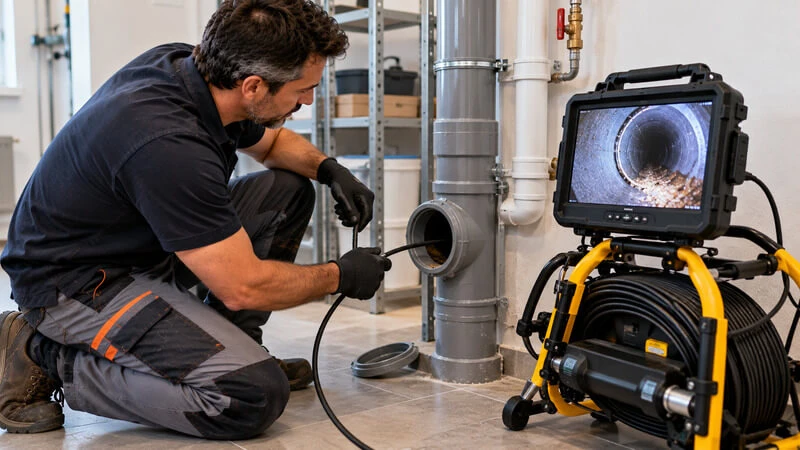
CCTV inspection uses a small camera introduced into accessible, compatible pipework.
It can help identify visible defects, displaced joints, obstructions or deterioration within certain drainage systems.
Unlike thermal imaging, CCTV provides an actual view of the pipe’s interior, but only where the camera can physically travel.
It cannot inspect every concealed pipe or replace other diagnostic methods when the suspected problem lies outside the camera’s accessible route.
Why Non-Destructive Diagnostics Matter for Property Owners
The practical value of modern diagnostics becomes clearer when considering the consequences of exploratory work.
Opening a wall or lifting flooring can involve more than removing a small section of material. The work may disturb tiles, plaster, waterproofing, insulation, decorative finishes or occupied rooms.
If the suspected location proves incorrect, additional areas may need to be opened.
A more targeted investigation can help reduce this uncertainty.
For homeowners, that may mean limiting disruption to kitchens, bathrooms or living areas. For commercial property managers, it may help maintenance teams plan access around occupants and building operations.
In apartment buildings, where plumbing can cross multiple units or shared service areas, identifying a likely source before undertaking repairs can also support better coordination.
Diagnostic findings may help determine which trades are needed, what materials could be affected and whether further testing is justified.
These benefits should not be confused with guaranteed savings or completely damage-free repairs.
Once a leak is located, physical access may still be required to repair or replace the affected pipework.
The purpose of non-destructive diagnosis is to make necessary intervention more informed, not to eliminate intervention in every case.
When Professional Leak Detection Is Worth Considering
Not every damp patch requires specialist equipment.
An accessible dripping connection, faulty toilet valve or leaking appliance hose may be identified through straightforward inspection.
Homeowners and maintenance teams can begin by checking visible plumbing connections, reviewing water consumption and looking for obvious sources of moisture.
However, a more detailed investigation may be appropriate when:
- Water consumption rises unexpectedly without an identifiable change in use.
- Damp patches repeatedly return after surface repairs.
- Moisture appears near concealed pipework but no visible leak can be found.
- Unexplained water sounds persist when fixtures are not operating.
- Flooring, walls or ceilings show continuing signs of moisture damage.
- The suspected source is underground or otherwise inaccessible.
These symptoms do not independently confirm a concealed plumbing leak.
For example, a damp wall could be affected by external water penetration, while unusual consumption might result from an intermittently running toilet.
An initial inspection aims to identify possible causes and determine what should be investigated next. A technical diagnosis goes further by evaluating evidence, testing relevant systems and narrowing down the likely source.
When moisture is close to electrical installations, occupants should avoid contact with affected equipment and seek appropriately qualified assistance.
A More Informed Approach to Building Maintenance
Modern leak detection technology is changing how concealed plumbing problems can be investigated.
Thermal cameras reveal surface temperature patterns. Acoustic instruments capture sounds and vibrations. Tracer gas can provide evidence of escaping gas in suitable systems, while moisture meters and CCTV cameras offer additional ways to assess conditions.
Each method has limitations, and no single instrument can resolve every case.
Their value lies in helping maintenance professionals gather evidence before deciding where to intervene.
For property owners and building managers, that supports a practical principle: investigate the likely cause, select the appropriate diagnostic method and carry out repairs where the evidence indicates they are needed.
By reducing reliance on unnecessary exploratory demolition, modern leak detection can contribute to more precise repairs and better-informed long-term building maintenance.